
Chokyi Dronma, Orgyan Chokyi, and the Gendering of Buddhist Life in Tibet
Chelsea L. Gutterman
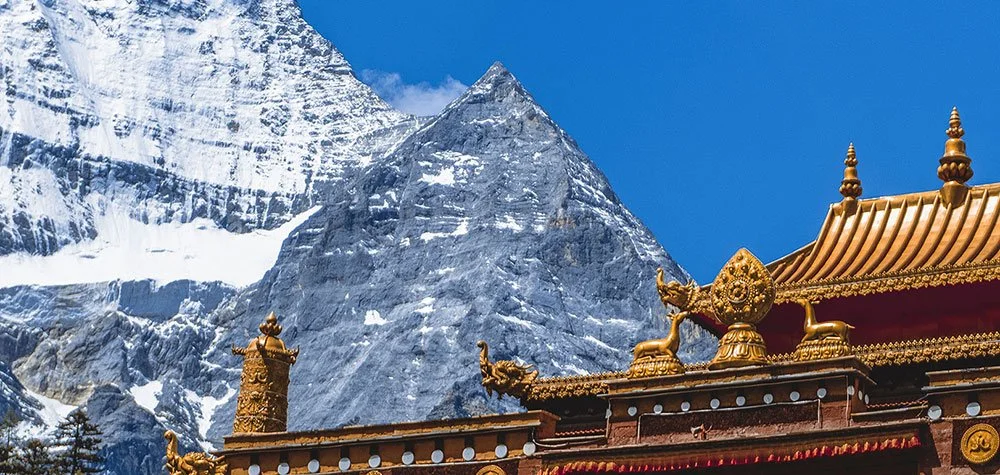
To many outsiders, hermit cultures have held a romantic, almost mythic appeal. Tibet, the expansive plateau region that shares borders with India, Nepal, and Bhutan, is one prominent example. For many Western audiences, a major recent exposure to Tibet came through the Hollywood film Seven Years in Tibet. Most people outside the region have never set foot there, much less experienced Tibetan life firsthand. Even some of the few travelers who did reach Tibet returned with what Janice Willis calls a “quite distorted picture.”¹
Because Tibet (... the “abode of snows”) is situated virtually at the top of the world and is fortified on three sides by many of the highest mountains on earth, the country itself until very recently was framed for its very remoteness and inaccessibility. Those few travelers and explorers who managed to reach Lhasa, Tibet’s capital city ...told of its magic and mysteries in grandiose and idealized fashion. Tibet was depicted as a type of “Shangri-la,” as a country where the sheer vastness and stark beauty of nature itself caused heightened awareness; where peace reigned eternally, where the Buddhist religion permeated all facets of life at all times; where celibate monks and nuns were prized above all other citizens and where such clerics--by the thousands--chose to live a life apart in cloistered enclaves continually engaged in religious endeavors.
The romanticization of Tibet is problematic. Such descriptions, Willis observes, are “a bit too idyllic and much too idealized.” They present a static, capital-centered picture of Tibetan life. In reality, daily life in Tibet, including economic activity, family relations, political conflict, ritual practice, and monastic labor, was “much more dynamic, bustling, diverse, and fluid.”² The lives of prominent female religious practitioners add still greater complexity to a landscape too often portrayed as spiritually uniform and overwhelmingly male.
Even into the twentieth century, Tibetan Buddhist women practiced in a variety of roles. They served as spirit mediums, religious singers, tantric adepts, hermits, and nuns.³ Female adepts remained far less visible in written records than their male counterparts. Apart from a relatively small number of exceptional figures, accounts of ordinary female practitioners are few and scattered.⁴ This absence does not mean that women played no substantial role in Tibetan religious life. It reflects the priorities of institutions and literary traditions that were more likely to preserve the biographies, teachings, and lineage histories of eminent men.
Tibetan women also encountered barriers within Buddhist institutions. Female birth could be associated with inferior karma, lower status, reduced intellectual capacity, or diminished spiritual opportunity. Religious life nevertheless offered some women an alternative to marriage, household labor, and the social expectations attached to motherhood. For some Tibetan women, Willis writes, it provided “a viable, even attractive, means by which to practice their faith.”⁵ Yet monastic life did not automatically remove gendered labor or prejudice. Women could enter religious communities only to find themselves assigned cooking, cleaning, and service work that left little time for advanced study or sustained retreat.
The surviving stories of exceptional women have sometimes transformed these difficulties into narratives of spiritual triumph. Such narratives require careful reading. They can reveal genuine acts of courage and religious accomplishment, but they can also turn suffering into a test that the heroine appears destined to overcome. The contrast to bear in mind concern the biographies of two prominent Tibetan women. Chokyi Dronma’s is a namthar, a religious life story organized around liberation and compiled by devoted followers. Orgyan Chokyi’s autobiography is more personal, yet it likewise belongs to a Buddhist literary tradition that gives suffering a spiritual purpose. Neither text is a neutral record of events. Each interprets a woman’s life in order to demonstrate religious significance.⁶
Chokyi Dronma lived from 1422 to 1455 and was born into the royal family of Gungthang. Orgyan Chokyi, born in 1675, came from a poor family in Dolpo and lived more than two centuries later. Their lives should therefore be compared thematically rather than treated as products of the same historical moment.
Chokyi Dronma’s life deserves attention because she resisted the role assigned to her as a royal daughter, diplomatic bride, wife, and mother. After leaving married life, she became a prominent Buddhist practitioner and eventually the first Samding Dorje Phagmo. Her significance extends beyond an individual struggle against gender expectations. She drew upon royal privilege, religious discipline, patronage, practical knowledge, and public service to establish an authority that survived her death through a female incarnation lineage.
Following her renunciation, Dronma did not simply withdraw from society. She begged for alms, supported religious communities, directed workers, participated in economic exchange, and promoted plans for irrigation and agricultural development. These activities complicate the assumption that Buddhist retreat required total separation from material life. Her religious authority grew partly from her ability to connect spiritual ideals with the practical welfare of a community.
Orgyan Chokyi’s and Dronma’s reveal striking polarities of female life in Tibet. Whereas Dronma possessed wealth, education, mobility, and access to powerful teachers, Orgyan Chokyi endured poverty, family violence, and compulsory labor. Her struggle continued after she entered religious life, where domestic duties repeatedly obstructed her desire for retreat and contemplation. She attained authority through persistence, religious practice, song, and autobiography rather than through the leadership of a wealthy institution.
Chokyi Dronma’s rejection of the gender role imposed upon her is upheld by the modern Western feminist viewpoint. Yet her actions should not be assessed solely in this light. She did not reject marriage merely in order to pursue personal independence. She understood her choices through Buddhist concepts of renunciation, vows, merit, compassion, lineage, and liberation. Her life challenged the gender ideology of her society from within a religious tradition that could both restrict women and provide them with resources for resisting restriction.
The comparison between Chokyi Dronma and Orgyan Chokyi therefore reveals more than two stories of exceptional nuns. It demonstrates that female Buddhist authority could develop through sharply different combinations of suffering, privilege, religious discipline, material labor, and institutional opportunity. Chokyi Dronma’s leadership was made possible by her refusal to remain within the limits of royal femininity, yet it was sustained by the resources and relationships attached to her royal birth. Orgyan Chokyi possessed fewer resources and exercised a quieter form of agency, but her preservation of her own voice challenged the conditions that might otherwise have erased her.
Together, their lives show that women’s religious achievement did not follow a single path. It could involve open resistance or patient negotiation, public leadership or solitary writing, the redistribution of wealth or the struggle to obtain time for meditation. Chokyi Dronma’s most enduring accomplishment was not merely that she became an exceptional woman in a male-dominated religious world. She helped create a form of female authority that could continue beyond her own lifetime.
Gender in Tibetan Buddhism
Buddhist teachings gave Tibetans an influential framework for understanding impermanence, suffering, causation, death, and rebirth. The doctrine of karma linked intentional action to future consequences and made religious practice meaningful within both present and future lives. Older historical writing sometimes converted this doctrine into broad claims about a single Tibetan personality, describing Tibetans as naturally “sympathetic, honest, cheerful, and satisfied with their lot.”⁷ Such generalizations are too sweeping. Karma did, however, shape a wide field of valued actions, including donations to religious communities, offerings of lamps and incense, recitation of scriptures, prostrations, circumambulations, and the release of animals destined for slaughter.⁸ Taking refuge in the Buddha, the teachings, and the religious community offered another recognized means of orienting life toward liberation and merit.⁹ Rituals for the dead likewise connected monasteries and specialists to lay communities by guiding the deceased toward an auspicious rebirth.¹⁰
These religious possibilities existed within a gendered social order. Texts and oral statements often associated female birth with inferior karma, lower status, and reduced spiritual ability.¹¹ Ani Dol-kar, a twentieth-century nun interviewed by Willis, repeated the view that women were more easily “spoiled” and therefore less capable of practicing the full range of Buddhist teachings.¹² Her statement should not be treated as a timeless Buddhist doctrine or a transparent description of all Tibetan women. It demonstrates the way in which institutional inequality could be internalized and expressed in religious language. A comparison with Korean gender ideology likewise suggests that Mahayana Buddhist ideas could interact with local systems of patriarchy, although the histories of Korea and Tibet should not be collapsed into a single model.¹³
Gender is useful here as a category of social practice rather than a fixed quality attached automatically to a female body. Candace West and Don Zimmerman’s account of “doing gender” emphasizes the repeated actions, judgments, and expectations through which social differences are produced and maintained.¹⁴ From this perspective, Chokyi Dronma’s problem was not simply that she had been born female. She was continually expected to perform a particular kind of femininity: obedient daughter, diplomatic bride, fertile wife, mother, and subordinate daughter-in-law. Her later authority depended on interrupting those expectations and demonstrating competence in fields that were not ordinarily associated with women.
The institutional structure of Tibetan monasticism intensified this inequality. Most Tibetan women historically lacked access to an uncontested lineage of full bhikshuni ordination and ordinarily received novice vows. Hagiographies describe a small number of women, including Chokyi Dronma, as fully ordained nuns, yet the status and ritual validity of those ordinations remain subjects of scholarly debate.¹⁵ The issue is important because the original draft repeatedly treats “ordination” as a clear and uniform threshold. In practice, women’s religious identities could include novice nun, fully ordained nun, yogini, tantric consort, hermit, teacher, visionary, or incarnation. These categories overlapped, and different communities did not always agree on their authority.
The term nun also captures only part of Dronma’s religious identity. After renouncing married life, she became a disciple of Bodong Chogle Namgyal and later maintained an important relationship with Thangtong Gyalpo. Her biography presents her as a fully ordained woman, a yogini, a tantric consort, an embodiment of Vajravarahi, and a major heir to her teacher. These identities could coexist within Tibetan hagiography, even though modern readers may expect “nun” and “consort” to be mutually exclusive. Her authority depended partly on recognition from eminent male masters. Once recognized, however, she transmitted teachings, attracted disciples, and created opportunities for other women.¹⁶
A feminist reading of Chokyi Dronma must therefore avoid two opposite errors. One would be to portray her as wholly trapped by Tibetan patriarchy. The other would be to celebrate her as a modern liberal individualist born several centuries too early. Her choices were intelligible within Buddhist concepts of renunciation, vows, compassion, lineage, and merit. Yet those choices also exposed and altered the gendered distribution of authority. Her life is most revealing when it is read at that intersection.
Chokyi Dronma’s Early Life in the Mundane World
Chokyi Dronma was born in 1422 into the royal family of Gungthang. Her mother had hoped for a son, yet the princess was cherished and displayed unusual religious inclination from an early age. Around 1438, when she was about sixteen, she was married to Tshewang Tashi, prince of Southern Lato.¹⁷ The marriage served political purposes. Dronma reportedly preferred a match with the royal house of Guge, which had longstanding ties with Gungthang, and women from Guge had previously married into the Gungthang line.¹⁸ Her father instead judged that an alliance with Southern Lato could reduce a military threat and secure the border.¹⁹ The episode makes the political value of a royal daughter unmistakable: her marriage was a diplomatic instrument before it was a personal relationship.
The biography represents her departure from Gungthang in cosmic terms. Her family and subjects grieve, and even the nonhuman world seems to mourn: “All the living beings of Ngari [Gungthang] felt as if they had lost their protector. It was as if the whole essence of the earth had been taken away (bcud phrogs pa) and the earth had turned bleak.”²⁰ This language should not be read as literal evidence that the whole kingdom lamented in the same manner. It is a hagiographic device that marks Dronma as extraordinary before her public religious career begins. Nature itself becomes a witness to the departure of a future saint.
Her marriage was troubled by political, familial, and religious conflict. The original draft describes her husband’s family as straightforward adherents of an indigenous religion called Bon. The situation was more complicated. Buddhism and Bon had long interacted in Tibet, and the figures called “Bonpo” in Dronma’s biography may have included institutional Bon practitioners, court priests, and specialists in local ancestral cults. Hildegard Diemberger argues that the biography uses “Bonpo” partly as a relational category for the non-Buddhist other against whom its Buddhist heroine could be defined.²¹ The label therefore contains historical information, polemical simplification, and literary convention at the same time.
This nuance changes the way in which the marital conflict should be interpreted. Buddhism had become deeply rooted in Tibet after its introduction during the imperial period, yet Buddhist institutions continued to coexist and compete with other ritual traditions.²² The spread of Buddhism was uneven and involved long processes of translation, patronage, political sponsorship, debate, and adaptation.²³ At Southern Lato, Dronma’s objections may have concerned a mixture of Bon rites, ancestral protections, and court rituals rather than a neatly bounded religion opposed to another neatly bounded religion.
The biography nevertheless presents her position without ambiguity. When priests arrived to perform rituals connected with her wedding, she declared, “I am a Buddhist; I am not a worshipper of the Bonpo. Please respect my beliefs!”²⁴ Her husband continued to support rites that she opposed. After a priest was summoned in connection with their infant daughter, who soon died, Dronma interpreted the tragedy through this religious conflict and blamed her husband’s disregard for Buddhism.²⁵ Modern readers should resist deciding which ritual caused what event. The more historically important point is that the child’s death became a decisive rupture in the narrative. Grief, marital tension, and religious aspiration converged.
Dronma then announced her desire to leave household life and become a nun. Her in-laws understood the decision as abandonment of marital and dynastic responsibilities. Her mother-in-law attempted to prevent her departure, and Dronma answered with an embodied act that could not easily be reversed: she cut off her own hair. The action was violent and hurried enough to wound her scalp, leaving her head bloody. The biography describes the result in deliberately unsettling language: “The lady’s shaved head was an awful sight, wet like a skin container for churning butter full of buttermilk.”²⁶
Her mother-in-law pleaded that Tshewang Tashi, already emotionally unstable, might die if Dronma left: “If this is how you are going to behave, Tshewang Tashi has no other option but to die, and I would rather die first!”²⁷ Dronma replied that gentle efforts had failed: “Now, by carrying out gentle actions, nothing meaningful has been achieved. I have to do something unheard of.”²⁸ The haircut was therefore both a religious gesture and a form of social argument. Long hair signified her place as a married noblewoman; removing it made the expected performance of that role visibly difficult. Her body became the medium through which she asserted that the previous arrangement could no longer continue.
The act should not be reduced to a timeless rejection of femininity. It was directed toward specific obligations. Her mother-in-law had already emphasized reproduction, responding to the birth of a granddaughter with the hope that more children would follow.²⁹ She later condemned Dronma’s withdrawal from maternal care by observing that even wolves and hawks attend to their young.³⁰ Dronma’s departure threatened the family because a royal wife was expected to produce heirs, stabilize alliances, and maintain the household. Her self-shaving interrupted all three functions.
At the same time, the biography does not portray her as fleeing abuse in the narrow sense. She was resisting a life that prevented the religious future she believed herself called to pursue. This distinction is significant. Her conflict arose from incompatible claims on her body and labor: the royal household viewed her as wife, mother, and dynastic resource; she increasingly understood herself as a renunciant and religious disciple. Cutting her hair did not settle every negotiation, but it altered the field of negotiation. It made her intention public, costly, and difficult to dismiss.
The Role of Pain: The Sufferings of Chokyi Dronma and Orgyan Chokyi
Pain occupies a prominent place in both women’s narratives, yet it functions differently in each. Orgyan Chokyi was born in 1675 in Dolpo, a Tibetan-speaking Himalayan region far from Dronma’s royal world. Her family was poor, her father suffered from leprosy, and her childhood memories center on hunger, accusation, and violence. She later recalled that from the ages of five to ten there was “suffering, yelling, unnecessary beating, and the food was not good.”³¹ Her parents blamed her for misfortunes over which she had no control. When her grandmother’s cow and calf were stolen, the child became the convenient object of anger.³² She ran to her father for help and was beaten instead: “I went to father, and got hit. Dirt got into my mouth and my hair, and then a rock went down my mouth.”³³ Her mother dismissed her speech with the accusation, “Girl, you tell awful stories!”³⁴
These episodes illustrate the vulnerability of a girl in a household under economic and physical strain. They also reveal the distinctive power of Orgyan Chokyi’s autobiography. Unlike the retrospective praise offered by Dronma’s disciples, Orgyan Chokyi writes through remembered sensation: dirt in her mouth, blows to her body, hunger, crying, and the repeated conviction that anguish had come upon her. Her account does not merely state that worldly life is suffering. It supplies suffering with a domestic location.
Religious life offered a possible alternative, although it was never guaranteed to be easy. Ani Dol-kar, a much later nun, similarly connected her vocation to the deaths of her four children and to the unbearable grief that followed.³⁵ Her teachers did not romanticize the choice. They warned that becoming a nun was difficult, then told her that the suffering she had already endured as a householder could become the ground for serious commitment.³⁶ Such testimony helps explain why religious life could appeal to women whose domestic circumstances had become painful or untenable.
In Orgyan Chokyi’s case, suffering gradually acquired Buddhist meaning. The doctrine of karma did not erase the violence, and it should not be used by modern readers to excuse her parents. It gave her a framework through which she could reinterpret resentment and cultivate compassion. Buddhist practice valued concern for sentient beings and linked compassionate action to merit and favorable rebirth.³⁷ Orgyan Chokyi eventually composed songs for her parents in which she mourned their ignorance and impermanence rather than answering violence with revenge. The achievement lies in her reinterpretation of pain, not in the pain itself.
Her adolescence brought further humiliation. Her father cursed and beat her in language that treated her like a diseased or contaminating creature.³⁸ Her mother instructed her in wool work and asked, “If a low-born girl does not know how to work with wool, from where will happiness come to you?”³⁹ She then threw a spindle and weaving shuttle at the girl’s head.⁴⁰ Orgyan Chokyi repeatedly summarizes such scenes with the phrase “Untold mental anguish came to me.”⁴¹ The repetition gives her autobiography a refrain. Violence becomes both a memory and a pattern through which she explains her turn toward religious refuge.
After one assault, she traveled to Shapku and met the monk Kunga Pendar and the nun Ani Paldzom.⁴² Their kindness introduced a radically different form of adult authority. Ani Paldzom “brought solace to my mind,” Orgyan Chokyi recalls. “I was feeling both joy and sorrow, and I wept a great deal.”⁴³ The tears register more than sadness. They mark the shock of receiving care after repeated blame.
Chokyi Dronma’s pain arose in a different setting. She possessed status, resources, and political connections, yet her aspirations collided with the obligations of marriage. The death of her daughter intensified that collision. Her self-inflicted wound during the cutting of her hair made the conflict visible and forced her household to confront the seriousness of her decision. Unlike Orgyan Chokyi, she acted directly and dramatically against the people obstructing her religious goal. The contrast should not become a hierarchy in which defiance is automatically superior to endurance. Each woman acted within a different range of available power.
The two narratives therefore do not prove that pain is spiritually necessary or especially characteristic of women. They show the way in which Buddhist life-writing converts suffering into religious intelligibility. In Dronma’s namthar, blood and grief authenticate renunciation. In Orgyan Chokyi’s autobiography, remembered abuse explains the search for refuge and later compassion. A careful reading preserves that religious meaning without turning violence into a gift. Their greatness lies in what they made from suffering, not in having suffered.
The Role of Retreat
Buddhism identifies ordinary existence with recurring dissatisfaction, impermanence, and rebirth, and it presents nirvana as liberation from that cycle.⁴⁴ Yet the path toward liberation took many institutional and practical forms. Donations, ritual practice, ethical discipline, study, meditation, pilgrimage, and retreat could all contribute to a religious life. For women, access to these practices was uneven. Female practitioners were often recognized only after demonstrating an exceptional degree of devotion, accomplishment, or charismatic power. The surviving historical record therefore highlights figures such as Machik Lapdrön, Yeshe Tsogyel, Mingyur Peldrön, and Shuksep Jetsünma, whose reputations exceeded the ordinary expectations imposed on nuns.⁴⁵
Chokyi Dronma’s privilege distinguished her from most women in this record. She belonged to a royal family, received an elite education, and displayed unusual aptitude for Buddhist teachings.⁴⁶ Her biography presents her religious understanding as almost innate, claiming that she mastered teachings with the ease of someone recalling knowledge from a former life.⁴⁷ Such praise belongs to the language of hagiography, yet her social advantages were concrete. Wealth, literacy, transportation, servants, and relationships with leading masters gave her opportunities that a poor woman could rarely obtain.
Privilege, however, could also obstruct the ascetic identity she sought. A princess who became a nun risked remaining surrounded by attendants and luxury. Alms begging offered a public method of renouncing that distinction. Dronma defended the practice by saying, “Alms begging is the essence of monastic life taught by the Buddha,” and, on another occasion, “This is just an ordained person’s duty.”⁴⁸ Observers were astonished to see a royal woman soliciting food like an ordinary renunciant.⁴⁹ The act had a double effect: it trained her in humility and announced that royal rank would not exempt her from discipline.
Her religious formation also deepened an ethic of compassion already praised in the biography. From childhood, she was represented as caring for beings who ranged from socially neglected people to lice on the human body.⁵⁰ During a visit to her mother, she heard that an elderly woman had fallen from a bridge and was badly injured. Dronma immediately asked that the woman be brought to her if alive and that her body be cared for if dead.⁵¹ Others feared contagion and hesitated. Dronma answered, “We used to pray to the bodhisattvas and promise that we would help all living beings. How can we not feel sorry for someone when we face a real situation, but only talk about it? Therefore I’ll go to see her on my own.”⁵² The scene connects contemplative vows to public action. Religious speech is tested by an actual body in need.
Orgyan Chokyi’s relation to retreat was less secure. She desired solitude for prayer and meditation, yet her community assigned her extensive kitchen labor. Her male teacher initially refused both her requests for retreat and her wish to record her own life.⁵³ This pattern fits the broader inequality described by scholars of Tibetan women, who often found themselves directed toward service work rather than advanced study or extended contemplation.⁵⁴ Orgyan Chokyi complained that she was trapped “in the kitchen of mistaken conventional reality, with no leisure day or night,” burdened by “the work of food and drink.”⁵⁵
Her teacher answered with a blunt division of labor: “Men are just right for the field, women are just right for the kitchen.”⁵⁶ Orgyan Chokyi did not accept the statement in silence. She continued to request release from kitchen service and eventually argued that monastery work had become indistinguishable from ordinary household labor: “Now I am an elder. Let me not be around too many people. Let me not work in the kitchen. Let the little ones engage in the bustle. The work at the monastery is no different from mundane work.”⁵⁷ Her resistance was quieter than Dronma’s haircut, but it was persistent. She named the contradiction between a community devoted to liberation and a labor system that reproduced domestic gender roles.
At other moments, Orgyan Chokyi repeated negative ideas about her own female embodiment. She prayed, “This female body is itself samsara, the round of existence. May I attain a male body, and keep the vows. May I never again be born in the body of a woman!”⁵⁸ Such words cannot be softened into a modern celebration of female identity. They reveal the degree to which spiritual possibility was imagined through masculine privilege. Yet the autobiography itself complicates the prayer. A woman who claimed that female birth obstructed liberation nevertheless created one of the earliest surviving Tibetan autobiographies by a woman. Her text performs an authority that its own rhetoric sometimes denies.
Retreat must also be understood more broadly than physical isolation. Tibetan monasteries and hermitages maintained close relationships with lay patrons, workers, families, and neighboring settlements; monks and laypeople participated together in many activities.⁵⁹ Women’s family obligations could follow them into religious life. Ani Dol-kar was told not to enter a nunnery permanently because she still had to care for younger siblings after the deaths of her parents. Her teacher advised periodic retreat instead.⁶⁰ Her case shows that female practitioners were expected to continue household and kinship duties even after making serious religious commitments.⁶¹ She obeyed by alternating practice with family service: “in Tibet, I would finish one retreat, then return home to check on the family. Then another retreat, then return home to check on the family. Then another retreat, and then home again.”⁶²
The institutional setting mattered. Nunneries generally commanded fewer resources, and women’s time was more likely to be consumed by cooking, cleaning, and support work. Administrative and economic work could teach useful skills, but it also reduced the time available for advanced study and contemplation.⁶³ Monasteries occupied a central place in Tibetan education, ritual, art, administration, and political life.⁶⁴ Families could gain merit and prestige by sending sons to become monks,⁶⁵ and monasteries also absorbed labor that might otherwise have lacked a stable economic place.⁶⁶ Consequently, the opportunity to study or retreat was never only a matter of personal devotion. It depended on labor arrangements, patronage, rank, and family wealth.
This material perspective clarifies the difference between the two women. Dronma’s retreat and itinerant practice were enabled by elite support, even when she deliberately renounced elite comfort. Orgyan Chokyi had to bargain for time that others controlled. Dronma’s alms begging was a chosen discipline that lowered her status symbolically; Orgyan Chokyi’s kitchen work was an imposed duty that reproduced her low status materially. Both experiences could become spiritually meaningful, yet they did not begin from the same position.
Retreat also prepared them for different forms of contribution. Dronma’s itinerancy exposed her to workers, donors, religious specialists, and local communities. Orgyan Chokyi’s solitude gave her the space to interpret her suffering, deepen contemplative practice, and compose a record of her life. Her legacy was textual and devotional rather than dynastic. The contrast demonstrates that female authority could be built through public organization or through the preservation of an interior voice.
Chokyi Dronma’s Return to Society as Leader
Chokyi Dronma did not renounce the world in order to disappear from it. After leaving married life and receiving religious vows, she became increasingly involved in the organization of communities, the movement of resources, the support of Buddhist teaching, and the welfare of laypeople. Her leadership combined religious charisma with skills that the original draft too quickly labels “business.” A more historically appropriate vocabulary is patronage, stewardship, redistribution, and institution building.
Her royal background remained important. Her mother provided land where her master and disciples could reside, a storehouse for barley at Kuthang in Nubri, and gifts for her retinue.⁶⁷ Visitors and followers also offered donations. These resources gave Dronma a foundation that most nuns lacked. Renunciation did not erase her networks; it redirected them. She used inherited and donated wealth to sustain teachers, disciples, workers, and religious projects.
Her plan for irrigation at Palmo Choding reveals the practical scope of that ambition. The project was not fully realized, and the essay should not claim that she single-handedly transformed a village into an economic stronghold. The plan nevertheless shows that she understood water management as a religious and social concern. She argued that channels near Palkhu Lake could irrigate a large area, increase rice production, benefit the population, and attract learned monks who would study and spread her master’s collected works.⁶⁸ Agriculture, scholarship, and the flourishing of Buddhism appeared in one program.
Dronma did more than propose the scheme. The biography depicts her inspecting work, giving detailed instructions, and participating in construction.⁶⁹ She had observed or supervised channel building elsewhere, including at Ganden, and carried that practical knowledge to Palmo Choding:
She gave lengthy instructions on how to build channels and everybody said, “We’re sure that our channels will be excellent!” She said, “It’s difficult for you to carry out the work to my satisfaction, but making channels is important to benefit the doctrine and living beings.”⁷⁰
The statement joins high standards to a collective purpose. Her authority did not rest only on visionary speech. It depended on directing labor.
Her dealings with workers and traders likewise reflect a redistributive ethic. The biography reports that she paid the workers and sold requested goods to them at one quarter of the price that established traders might have charged.⁷¹ A modern economic reading might call this a loss-leading strategy or a method of securing loyalty, but such language narrows the scene. The transaction displays generosity, patronage, and the creation of reciprocal bonds. Keeping workers “happy” strengthened the community surrounding the religious project and translated compassion into material terms.
Dronma also challenged secular hierarchy, although she did not reject hierarchy altogether. When a high official from Northern Lato visited, she received him without the honorific language and protocol expected at court.⁷² By contrast, she later treated a low-ranking monk carrying water with conspicuous respect, personally indicating where he should sit.⁷³ “Although the water carrier has a very low rank,” she said,
he is a monk. My ancestors who were bodhisattvas [...] behaved with great kindness toward all living beings and showed great respect to those who were wearing the monastic robes. ... The water carrier is a son of the Buddha and he should be respected.⁷⁴
The episode does not prove a modern principle of universal equality. It demonstrates a reordering of rank: monastic identity and Buddhist commitment took precedence over secular office.
Alms begging enacted the same reordering. Members of her entourage objected that begging was unsuitable for a princess.⁷⁵ Dronma insisted that an ordained person could not claim exemption from a central discipline merely because of birth.⁷⁶ The practice lowered her publicly, yet that chosen humility increased her religious authority. She could ask others to support Buddhist institutions because she had visibly accepted the obligations of renunciation herself.
Her most consequential achievement came after her death. Chokyi Dronma had been recognized as an embodiment of Vajravarahi, Dorje Phagmo in Tibetan, and as a principal spiritual heir within the Bodong tradition. Her disciples later identified a young girl as her reincarnation. That recognition established the Samding Dorje Phagmo line, one of the earliest and most influential female incarnation lineages in Tibet.⁷⁷ The phrase “religious dynasty” captures the institutional innovation. Authority passed neither through a husband nor through a biological son. It continued through the recognition and training of another girl.
This reincarnational succession alters the meaning of Dronma’s renunciation. Her departure from marriage did not end dynastic life; it helped create a different kind of dynasty. The new lineage depended on monasteries, teachers, patrons, biographies, ritual recognition, and the memory of her achievements. Her namthar participated directly in that process by presenting her body, choices, and deeds as signs of sanctity. The text was therefore not merely a record of authority. It was one of the instruments that made authority durable.
Orgyan Chokyi’s return to society was less public and less institutionally powerful. She did not establish an incarnation line or command royal resources. Her prayers, songs, counsel, and autobiography nevertheless gave later readers access to the interior life of a woman whose labor and suffering might otherwise have vanished from the record. Her authorship itself was a form of leadership. She preserved an account of female religious struggle despite the resistance of a male teacher and despite her own limited education. Where Dronma created a lineage of bodies, Orgyan Chokyi created a lineage of testimony.
Conclusion
Chokyi Dronma and Orgyan Chokyi began from sharply unequal positions. Dronma was a princess whose birth supplied wealth, education, mobility, and access to eminent teachers. Orgyan Chokyi was a poor girl in Dolpo who endured hunger, blame, physical violence, and compulsory labor. Their religious careers cannot be treated as proof that Buddhist renunciation placed everyone at the same starting point. Social inequality followed practitioners into religious institutions, where rank, patronage, education, and gender continued to shape opportunity.
The comparison remains valuable because both women transformed constraints into religious forms of authority. Pain stands near the threshold of each narrative, although it should not be glorified. Dronma’s grief and self-wounding made her renunciation publicly undeniable. Orgyan Chokyi’s memories of abuse drove her toward people who offered compassion and later gave her a vocabulary for extending compassion even to those who had harmed her. In both cases, suffering became narratively meaningful. It did not become morally good.
Retreat likewise meant different things for them. Dronma used alms begging, travel, and service to loosen the identity of princess and acquire the public credibility of a renunciant. Orgyan Chokyi struggled to secure freedom from kitchen work and enough solitude for sustained practice. Dronma’s privilege allowed her to choose forms of humility. Orgyan Chokyi had to resist the labor assigned to her because of low status and gender. Their stories therefore reveal both the promise and the limits of religious withdrawal.
Dronma’s later leadership was remarkable because it connected spiritual authority to material care. She organized resources, paid workers, circulated goods, planned irrigation, honored monastic discipline, and imagined agricultural prosperity as support for Buddhist learning. Her practical projects did not distract from religion. They made a religious community possible. The foundation of the Dorje Phagmo incarnation line then extended her authority beyond a single lifetime and opened a durable institutional role for women.
A modern feminist reader may hear an echo of Betty Friedan’s claim that women could “no longer ignore that voice within” which wanted “something more than my husband and my children and my home.”⁷⁸ The comparison can illuminate Dronma’s refusal to accept domestic life as the limit of her vocation. Its limits are equally important. Dronma did not seek individual fulfillment in the language of twentieth-century liberal feminism. She sought Buddhist vows, discipleship, compassion, merit, and the continuation of a religious tradition. Her challenge to gender was embedded in those aims.
Chokyi Dronma’s life is therefore best understood neither as a simple triumph over femininity nor as an escape from society. She changed the terms on which a woman could occupy religious authority. Her royal birth gave her resources, her renunciation gave her credibility, her disciplined practices gave her sanctity, her public work gave her followers, and her biography helped give her a successor. Orgyan Chokyi’s quieter career shows the costs borne by women without comparable privilege and the authority that could still be claimed through persistence and writing. Together, their lives reveal female Buddhist agency as embodied, institutional, material, and literary. That is the broader significance of a woman who left one dynasty and became the origin of another.
Bibliography
Diemberger, Hildegard. “The Buddhist Princess and the Woolly Turban: Non-Buddhist Others in a 15th-Century Biography.” Revue d’Études Tibétaines 15 (November 2008): 337–356.
Diemberger, Hildegard. When a Woman Becomes a Religious Dynasty: The Samding Dorje Phagmo of Tibet. New York: Columbia University Press, 2007.
Friedan, Betty. The Feminine Mystique. New York: W. W. Norton, 1963.
Gyatso, Janet, and Hanna Havnevik, eds. Women in Tibet. New York: Columbia University Press, 2005.
Kapstein, Matthew. The Tibetans. Malden, MA: Blackwell, 2006.
Schaeffer, Kurtis R. “The Autobiography of a Medieval Hermitess: Orgyan Chokyi (1675–1729).” In Women in Tibet, edited by Janet Gyatso and Hanna Havnevik. New York: Columbia University Press, 2005.
Schaeffer, Kurtis R. Himalayan Hermitess: The Life of a Tibetan Buddhist Nun. New York: Oxford University Press, 2004.
Shakabpa, Wangchuk Deden. Tibet: A Political History. New Haven: Yale University Press, 1967.
Snellgrove, David, and Hugh Richardson. A Cultural History of Tibet. Bangkok: Orchid Press, 2003.
Sorensen, Clark W. “The Myth of Princess Pari and the Self Image of Korean Women.” Anthropos 83, nos. 4/6 (1988): 403–419. www.jstor.org/stable/40463374.
West, Candace, and Don H. Zimmerman. “Doing Gender.” Gender and Society 1, no. 2 (June 1987): 125–151. www.jstor.org/stable/189945.
Willis, Janice D. “Tibetan Ani-s: The Nun’s Life in Tibet.” The Tibet Journal 9, no. 4, Special Issue (Winter 1984): 15–30. www.jstor.org/stable/43302196.
Wu, Fan. “Fully Ordained Nuns in Fourteenth-to-Seventeenth Tibetan Hagiographical Narratives.” Religions 13, no. 11 (2022): 1037. https://doi.org/10.3390/rel13111037.
Endnotes
¹ Janice D. Willis, “Tibetan Ani-s: The Nun’s Life in Tibet,” The Tibet Journal 9, no. 4, Special Issue (Winter 1984), 16, www.jstor.org/stable/43302196.
² Willis, “Tibetan Ani-s,” 16.
³ Willis, “Tibetan Ani-s,” 15.
⁴ Willis, “Tibetan Ani-s,” 15.
⁵ Willis, “Tibetan Ani-s,” 19.
⁶ Diemberger, When a Woman Becomes a Religious Dynasty, especially 1–45; Schaeffer, Himalayan Hermitess, 3–13; Fan Wu, “Fully Ordained Nuns in Fourteenth-to-Seventeenth Tibetan Hagiographical Narratives,” Religions 13, no. 11 (2022): 1037.
⁷ Wangchuk Deden Shakabpa, Tibet: A Political History (New Haven: Yale University Press, 1967), 18.
⁸ Matthew Kapstein, The Tibetans (Malden, MA: Blackwell, 2006), 216.
⁹ Kapstein, The Tibetans, 216.
¹⁰ Kapstein, The Tibetans, 215.
¹¹ Janet Gyatso and Hanna Havnevik, eds., Women in Tibet (New York: Columbia University Press, 2005), 9.
¹² Willis, “Tibetan Ani-s,” 27.
¹³ Clark W. Sorensen, “The Myth of Princess Pari and the Self Image of Korean Women,” Anthropos 83, nos. 4/6 (1988): 403, www.jstor.org/stable/40463374.
¹⁴ Candace West and Don H. Zimmerman, “Doing Gender,” Gender and Society 1, no. 2 (June 1987): 125–151, www.jstor.org/stable/189945.
¹⁵ Wu, “Fully Ordained Nuns,” 1037. Wu emphasizes that Tibetan hagiographies sometimes describe women as fully ordained even though the ritual validity and institutional recognition of those ordinations remain contested.
¹⁶ Diemberger, When a Woman Becomes a Religious Dynasty, 144–148; Wu, “Fully Ordained Nuns,” 1037.
¹⁷ Hildegard Diemberger, When a Woman Becomes a Religious Dynasty: The Samding Dorje Phagmo of Tibet (New York: Columbia University Press, 2007), 58.
¹⁸ Diemberger, When a Woman Becomes a Religious Dynasty, 55.
¹⁹ Diemberger, When a Woman Becomes a Religious Dynasty, 55.
²⁰ Diemberger, When a Woman Becomes a Religious Dynasty, 56.
²¹ Hildegard Diemberger, “The Buddhist Princess and the Woolly Turban: Non-Buddhist Others in a 15th-Century Biography,” Revue d’Études Tibétaines 15 (November 2008): 337–356.
²² Kapstein, The Tibetans, 45–50.
²³ Shakabpa, Tibet: A Political History, 17–18.
²⁴ Diemberger, When a Woman Becomes a Religious Dynasty, 159.
²⁵ Diemberger, When a Woman Becomes a Religious Dynasty, 166.
²⁶ Diemberger, When a Woman Becomes a Religious Dynasty, 171.
²⁷ Diemberger, When a Woman Becomes a Religious Dynasty, 171.
²⁸ Diemberger, When a Woman Becomes a Religious Dynasty, 171.
²⁹ Diemberger, When a Woman Becomes a Religious Dynasty, 163.
³⁰ Diemberger, When a Woman Becomes a Religious Dynasty, 165.
³¹ Kurtis R. Schaeffer, Himalayan Hermitess: The Life of a Tibetan Buddhist Nun (New York: Oxford University Press, 2004), 134.
³² Schaeffer, Himalayan Hermitess, 134.
³³ Schaeffer, Himalayan Hermitess, 134.
³⁴ Kurtis R. Schaeffer, “The Autobiography of a Medieval Hermitess: Orgyan Chokyi (1675–1729),” in Women in Tibet, ed. Janet Gyatso and Hanna Havnevik (New York: Columbia University Press, 2005), 89.
³⁵ Willis, “Tibetan Ani-s,” 25.
³⁶ Willis, “Tibetan Ani-s,” 25.
³⁷ Kapstein, The Tibetans, 216–217.
³⁸ Schaeffer, “The Autobiography of a Medieval Hermitess,” 89.
³⁹ Schaeffer, Himalayan Hermitess, 135.
⁴⁰ Schaeffer, Himalayan Hermitess, 135.
⁴¹ Schaeffer, Himalayan Hermitess, 134–135.
⁴² Schaeffer, Himalayan Hermitess, 134.
⁴³ Schaeffer, Himalayan Hermitess, 134.
⁴⁴ Kapstein, The Tibetans, 215.
⁴⁵ Kapstein, The Tibetans, 200.
⁴⁶ Diemberger, When a Woman Becomes a Religious Dynasty, 152–159.
⁴⁷ Diemberger, When a Woman Becomes a Religious Dynasty, 153.
⁴⁸ Diemberger, When a Woman Becomes a Religious Dynasty, 177–179.
⁴⁹ Diemberger, When a Woman Becomes a Religious Dynasty, 61, 178–179.
⁵⁰ Diemberger, When a Woman Becomes a Religious Dynasty, 153.
⁵¹ Diemberger, When a Woman Becomes a Religious Dynasty, 205.
⁵² Diemberger, When a Woman Becomes a Religious Dynasty, 205.
⁵³ Gyatso and Havnevik, Women in Tibet, 10.
⁵⁴ Gyatso and Havnevik, Women in Tibet, 9–10.
⁵⁵ Schaeffer, Himalayan Hermitess, 157.
⁵⁶ Schaeffer, Himalayan Hermitess, 160.
⁵⁷ Schaeffer, Himalayan Hermitess, 161.
⁵⁸ Schaeffer, Himalayan Hermitess, 100.
⁵⁹ David Snellgrove and Hugh Richardson, A Cultural History of Tibet (Bangkok: Orchid Press, 2003), 247–248.
⁶⁰ Willis, “Tibetan Ani-s,” 26.
⁶¹ Kapstein, The Tibetans, 219.
⁶² Willis, “Tibetan Ani-s,” 26–27.
⁶³ Kapstein, The Tibetans, 219.
⁶⁴ Kapstein, The Tibetans, 219.
⁶⁵ Kapstein, The Tibetans, 219.
⁶⁶ Kapstein, The Tibetans, 219.
⁶⁷ Diemberger, When a Woman Becomes a Religious Dynasty, 210.
⁶⁸ Diemberger, When a Woman Becomes a Religious Dynasty, 212.
⁶⁹ Diemberger, When a Woman Becomes a Religious Dynasty, 211–212.
⁷⁰ Diemberger, When a Woman Becomes a Religious Dynasty, 211.
⁷¹ Diemberger, When a Woman Becomes a Religious Dynasty, 202.
⁷² Diemberger, When a Woman Becomes a Religious Dynasty, 160.
⁷³ Diemberger, When a Woman Becomes a Religious Dynasty, 161.
⁷⁴ Diemberger, When a Woman Becomes a Religious Dynasty, 161.
⁷⁵ Diemberger, When a Woman Becomes a Religious Dynasty, 177–178.
⁷⁶ Diemberger, When a Woman Becomes a Religious Dynasty, 178.
⁷⁷ Diemberger, When a Woman Becomes a Religious Dynasty, 1–6, 235–296.
⁷⁸ Betty Friedan, The Feminine Mystique (New York: W. W. Norton, 1963), 32.
