
Games of Nationhood: Boycotts of the Summer Olympics in the Twentieth Century
Emma Sokolova
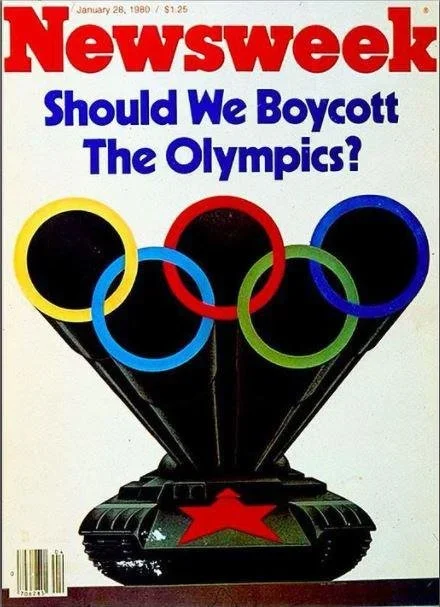
The front cover of Newsweek magazine 28 January 1980, historyfirst.com
I. Introduction: The Original Mission of the IOC
Like the League of Nations and the United Nations, the International Olympics Committee is a global organization responsible for ensuring the fair representation of all sovereign nations in pursuit of a common purpose and, accordingly, has been called a “government of sport.”¹ Today, the organization includes nearly all 193 countries that are members of the United Nations. Founded on 23 June 1894 in Paris, France, the International Olympics Committee was started and subsequently organized by Pierre de Coubertin (1863-1937).² Coubertin believed that reviving the ancient Greek Olympic games in modern Europe would contribute to cross-cultural understanding and help prevent wars. He envisioned an international sporting venue that would build political bridges by transcending political divisions.
That goal, while laudable, has been challenging to achieve since the founding of the Olympics. Over the 124 years of their modern history, the Olympic games have coincided with two world wars (1914-1918; 1937-1945), the dissolution of the European empires, decolonization, and the Cold War (1947-1991). In constant tension with the mission of the International Olympics Committee, global politics have often intersected with the holding of the games, at times resulting in formal boycotts by participating countries. As such, the Olympics provide a valuable window for examining modern world history, modern nation-building, and the politics of the Cold War. By examining historical instances when the Summer Olympic Games were politicized, this paper attempts to document how countries large and small used the venue of an international organization in their attempts to influence global and domestic opinions. As we will see below, Olympic boycotts often had great impacts. And yet, this paper argues that while the boycotting of the Olympics reveals that the Games have always been to some degree political, it will also suggest that the boycotts have not always been successful at achieving their original aims. Furthermore, this paper cautions against overly stressing the “political” nature of the games, considering that each individual Game had a distinct geopolitical context and diplomatic background.
This paper addresses the issue of modern nationhood vis-à-vis the original mission of the Olympics by focusing on the five of the most infamous boycotts of the Summer Olympics. Together, these boycotts represent the five “most” politicized Games in the history of the Olympics. These included the 1956 Games in Melbourne, Australia, the 1964 Games in Tokyo, Japan, the 1976 Games in Montreal, Canada, the 1980 Games in Moscow, the Soviet Union, the 1984 Games of Los Angeles, the United States, and the 1988 Games in Seoul, South Korea. These were the only instances in history in which the Olympics were formally boycotted by a member country or countries of the International Olympic Committee. All these boycotts coincided specifically with the Cold War, and none have occurred since the end of the Cold War. Many involved disputes between blocs of newly created nation-states, which sought to balance between the two competing Superpowers: the United States and the Soviet Union.
The relationship between sporting events and politics is complex. On the one hand, sports organizers often decry the invocation of politics in sports—the International Olympics Committee being no exception.³ But on the other hand, a historical analysis of sports demonstrates that games are frequently an outlet for promoting and advancing political agendas.⁴ Of all the types of sporting events that exist, the Olympics serve as one of the most powerful vehicles of global influence due to the worldwide participation and widespread media attention they receive.⁵ Using the United States as a brief example once more, during the 1968 Olympics in Mexico City, two black sprinters named Tommy Smith and John Carlos enacted a black power salute on the medal podium as a call for attention to the Civil Rights Movement ongoing in the U.S.⁶ Of course, the charter of the International Olympics Committee explicitly tries to separate politics from sports—a fact which produced routine tension during the planning and holding of the Summer Olympics.
The boycotts of the Summer Olympic Games—situated between 1956 and 1988—nearly perfectly align with the historical periodization of the Cold War between the United States and the Soviet Union and the growth of independent nation-states in the Post-War period. With the notable exceptions of the 1980 and 1984 Games, most of the boycotting countries were not the two superpowers, but rather third countries struggling to come to terms with their own independence and international recognition. This observation has led some scholars to argue that only the boycotts of 1980 and 1984 should be strictly seen as “Cold War boycotts.”⁷ Indeed, in some cases, “Cold War” politics strictly speaking did not always inform the boycotts, but this paper suggests that the Cold War nonetheless provided a geopolitical background in which boycotts became routinized.⁸ And yet, boycotts of the Summer Olympics have not happened since the end of the Cold War. Therefore, it is not accurate to argue that the Olympics have always been political; rather, the Olympics have always had the potential to be political, and sometimes have been.
The paper is divided into four sections, each exploring a different boycott of the Summer Olympics. Following an overview of the secondary literature on politics and the Olympics and an introduction providing historical background for the act of boycotting the Olympics from prior to the Cold War, the first content section looks at the “Cold War Satellite Boycotts” of the 1956 and 1964 Summer Games concerning events over Hungary and Taiwan. The second section examines the “African Boycott” of the 1976 Games, which focused on Apartheid South Africa. The third explores the “Superpower Boycotts” of the 1980 and 1984 Games, wherein the United States and the Soviet Union respectively boycotted each other’s’ Olympic Games, as well as the North Korean boycott of the 1988 Games, which was the last time the games have been formally boycotted. The fourth section considers academic literature that argues that boycotts have often been ineffective or, in line with the International Olympics Committee, that the Olympics are not invariably political. Together, these examples serve to show that boycotts, even while contrary to the original mission of the International Olympics Committee, are essential to the spectacle and influence of the Games and were particularly so during the Cold War. Despite the International Olympic Committees insistence on keeping politics out of the Olympics, boycotts occurred at the Olympics because the Games were seen as important; if the Games were not deemed important, there would be no boycotts. One could even say that the Olympic Games need boycotts to maintain their relevance on the global stage.
II. “A Non-Political Entity”? Alternative Views of the Role of Politics in the Olympics
It may appear surprising to observe that the International Olympics Committee was a deeply political institution and the Olympics a thoroughly political event when the IOC’s own charter takes an explicitly apolitical stance. Different scholars have formulated various approaches to the question of politics in the Olympics, but most have generally stressed the consistency of politics in the holding of the Games. David B. Kanin for instance argues that it is a mistake to identify a specific date when the Olympics “became” political, as such an approach “leaves the impression that once upon a time the Games were truly free of political interference.”⁹ In Kanin’s view, the Games have been political since their revival in the early twentieth century. Jules Boykoff likewise argues that the “the Olympics are political through and through.”¹⁰ Boykoff agrees with Kanin that politics have been a consistent feature of the Olympic Games.
But this seemingly ubiquitous scholarly consensus around the political nature of the Olympics remains in awkward tension with the charter of the International Olympics Committee, which attempts to separate the Games from politics. How, then, is a scholar supposed to weigh this apparent divergent between ideals and realities? In answering this question, we might begin by questioning just how strong the “political” trends of the Olympics have been over time. Considering that since their re-creation in modern times, twenty-eight Summer Olympics Games have been held in twenty-three cities, the fact that only six games (twenty-one percent) have been boycotted by a number of countries represents a record of relative success for the International Olympics Committee, which nearly always opposed boycotts of the Games.¹¹ The Winter Olympics have never been formally boycotted, though boycotts have been consistently threatened for them as well. Future scholarship might well interrogate the question of why boycotts have invariably focused on the Summer, rather than the Winter, Games. In sum, it is important to not overstate the role that politics has had within the Games. While the boycotts were an important phenomenon in Olympic history, we have to keep in mind that they were all formally limited to the Cold War period, and the basic fact that most Olympics were never boycotted.
In other words, while it makes sense to say that the Olympics have always held the potential for engaging politics, it seems disingenuous to argue that the Olympics have “always” been political, especially when the history record clearly shows that some Games were more controversial than others. Overly stressing the politicization of the Olympics flattens the existing record so that every Game is weighed as equally controversial as any other. As the discussion below will reveal, this was clearly not the case.
III. Boycotts and the Growth of Nation States Participating in the Summer Olympics
The Olympic Games first originated in Ancient Greece in 776 B.C. and continued until 394 A.D., when the Emperor Theodosius I of Rome banned them. For nearly 1,600 years, no Olympics or any transnational events under that title were held. The first modern Olympic games were held in 1896, two years after the establishment of the International Olympics Committees. The first games, unsurprisingly, occurred in Athens, Greece. Over the ensuing decades, the number of participating countries seated on the International Olympics Committee participating in the Games has increased considerably. Today, the first goal of the Olympic Movement remains contributing “to building a peaceful and better world by educating youth through sport practiced in accordance with Olympism and its values.”¹²
The governing rules of the International Olympics Committee are preserved in the published editions of the Olympic Charter, which tend to be updated before each Summer Olympics. The current edition of the charter addresses questions of politics in a few sections. The 2020 edition of the charter says that “Recognizing that sport occurs within the framework of society, sports organizations within the Olympic Movement shall apply political neutrality.”¹³ The International Olympic Committee has nearly always professed “political neutrality” when disputes over the Games have arisen. The document also secures the “rights and freedoms” of all participating countries from “discrimination of any kind, such as race, color, sex, sexual orientation, language, religion, political or other opinion.”¹⁴ Most importantly, the charter defines the International Olympics Committee’s goal as “maintaining and promoting its political neutrality and to preserve the autonomy of sport.”¹⁵ Clearly, the official policy of the International Olympics Committee is to attempt to preserve “political neutrality” in all negotiations for the organizing of the Games. Though admirable, as we will see below, this goal has been difficult to achieve consistently throughout the Summer Olympics’ modern history.
The first Olympic Charter was published in French in 1908. Though much shorter than later editions of the texts, the International Olympics Committee even then strove to set out egalitarian ideals. The 1908 edition of the text read, “Le Comité International Olympique est permanent et se recrute lui-même à raison d'un membre au moins, de trois au plus pour chaque pays représenté. Le nombre des pays représentés n'est pas limité” (“The International Olympic Committee is permanent and recruits itself at the rate of at least one member, at most three for each country represented. The number of countries represented is not limited”).¹⁶ From its inception, the Olympics Committee desired for the widest possible range of countries to participate in the games, promised to secure representatives from each country on the permanent standing committee, and vowed to not set any limit on the number of countries that could be represented. True to its original goals, membership in the IOC has steadily grown since the early twentieth century.
As one might expect, the number of countries participating in the Olympic Games has steadily increased over the decades. In the 2016 Summer Olympics in Rio, 206 nations (195 sovereign states according to the UN, plus some territories without formal recognition, such as Taiwan) participated in the games.¹⁷ From the early twentieth century, the earliest participating countries were largely European, but again the geographical scope expanded with the growth of the Summer Games generally and the increasing pace of decolonization.
In examining the first fifty years of the Summer Olympics, we can note a few general observations. First, the Olympics were cancelled three times due to the First and Second World Wars. In light of their growing power in the early decades of the twentieth century, Germany and Japan were in fact invited to host the Games; Germany did under the Nazi Regime in 1936, though the Tokyo Games planned for 1940 were cancelled due to the conflict. The International Olympics Committee “punished” Germany and Japan respectively for engaging in aggression, though the two countries were reinstated into the International Olympics Committee by 1952.¹⁸ The 2020 cancellation of the Summer Olympics in Tokyo is the first time the Games have been cancelled since the end of the Second World War.¹⁹
Second, we should also notice that boycotts did not necessarily correspond to decreased attendance in terms of the number of countries. Since the number of countries participating in the Olympics gradually increased over the decades, boycotts did not necessarily have a large impact on attendance even if they had a significant impact on politics. The two exceptions to this were the 1976 “African” Boycott, which saw a number of African countries decline attendance due to New Zealand’s team visit to South Africa, and the 1980 U.S.-led boycott of the Moscow Games, which created even lower attendance than the 1976. We might also notice that the Olympic Games from 1976 to 1988 saw four boycotts in immediate succession—which was the first time such a pattern occurred in the history of the event. This unique succession of boycotts was likely related to the final chapter of the Cold War.
The first Summer Olympics to have elicited a substantial controversy was the 1936 Summer Games in Berlin. Germany had been awarded with the right to host of the Games in 1931, two years prior to the ascent of the Nazis in national politics.²⁰ After Hitler’s election, the International Olympics Committee, citing political “neutrality,” did not support any boycott of the Games.²¹ Soon after Hitler came to power in Germany in 1933, observers in the United States and other western countries questioned the morality of supporting the Olympic Games in Berlin, since the Nazis were actively campaigning against letting Jewish athletes play.²² The Nazi Party exploited the Olympics in 1936 in an ostentatious attempt to promote their anti-Semitic ideals and to establish the dominance of the Aryan race and Germany over other countries in sport.
In 1933, responding to reports of the persecution of Jewish athletes, Avery Brundage, chair of the American Olympic Committee (AOC), stated publicly, “The very foundation of the modern Olympic revival will be undermined if individual countries are allowed to restrict participation by reason of class, creed, or race.”²³ Brundage had initially considered boycotting the Summer Games, or at least moving them from Germany to a third country. Brundage ultimately dropped his opposition to having the United States participate in the Games after he briefly toured a German sports facility in 1934 during a German-organized propaganda tour and determined that Jewish athletes appeared to be treated fairly. In spite of Brundage’s change of heart, individual Jewish athletes from the United States, France, and a few other countries also chose to boycott the Berlin Olympics.²⁴ The American Jewish Congress and the Jewish Labor Committee supported a boycott of the Berlin Games.²⁵ And yet, the American Olympic Committee, which represented the United States within the International Olympic Committee, eventually came to oppose any boycott of the Nazi Olympics in spite of the fact that Nazi Germany and the United States would be at war five years later.
Discussions about potentially boycotting the Berlin Games also surfaced in Great Britain, France, Sweden, Czechoslovakia, and the Netherlands.²⁶ Joseph Stalin’s Soviet Union and the Communist International organization supported Spanish efforts to boycott the Games and host them in Barcelona that same year. These efforts were serious and extensive and were the greatest challenge to the Nazi Olympics in 1936. A total of 6,000 athletes from twenty-two nations, including the United States and the Netherlands, had planned to attend the alternative event in lieu of the Games.²⁷ However, the outbreak of the Spanish Civil War just as the Games were about to begin saw the cancellation of the “People’s Olympiad,” and Hitler’s Summer Games in Berlin carried on without any significant competition.²⁸ Forty-nine teams from around the world competed in the Berlin Games, more than in any previous Olympics to that date.
The 1936 Summer Olympic Games in Berlin provided an important precedent for boycotting the event, even if the efforts to boycott the Nazi Olympics ultimately failed. In the years after the Second World War, the International Olympics Committee looked upon Hitler’s hosting of the games as a grave embarrassment for the organization, and the voices of many protestors who desired a boycott were ultimately vindicated. The efforts of the IOC to maintain the Games as a politically “neutral” venue were ultimately shown to be futile, even contradictory. Later, when the IOC perceived that a boycott was likely due to a member state’s engagement in heinous political acts, it sought to preemptively expel the state from the committee to prevent a boycott. South Africa became the most famous example of this practice in the second half of the twentieth century.²⁹
This post-war memory of the Berlin Olympics would ultimately prove critical over the following four decades. A precedent had been established: not a precedent for boycotting the Olympics, but a precedent explicating the consequences for not boycotting them in line with the professed wishes of the International Olympics Committee. Clearly, the IOC had a checkered past in regard to political decisions. Just over a decade after the Second World War, the IOC would face the first true boycott of the Summer Games at the 1956 Olympics in Melbourne, Australia.
IV. The “Cold War Satellite Boycotts” at the 1956 and 1964 Summer Games
The first Summer Olympics to see sustained political boycotts were the 1956 Games in Melbourne, the first Olympic event to be held in the Southern Hemisphere. Boycotts also followed eight years later at the 1964 Summer Games in Tokyo, the first to be held in Asia. What the boycotts of both of these Olympics had in common was that they concerned contested satellite boundaries of the Communist world: Hungary in the case of the Soviet Union and Taiwan in the case of China. The newly-created state of Israel was also involved in the political considerations behind both boycotts. These two boycotts would go on to have significant geopolitical consequences and challenge the International Olympics Committee to strategically address the question of politics and nationhood in sport.
Global politics affected the 1956 Games from the outset. Israel, newly created out of British Mandate Palestine in 1948, launched an invasion of Suez, which galvanized Egypt, Iraq, Cambodia, and Lebanon to announce that they would not participate in the Games.³⁰ To be clear, these actions were not perceived as boycotts per se in light of the ensuing conflict, but they reflected the generally unsettled political climate that saw members of the International Olympics Committee fail to participate in the Games. Clearly, while internationalism drove the ideals of the International Olympics Committee, conflicts arose between recently founded nations formed out of the nexus of older empires, affecting the 1956 Games.
The central boycotts of the 1956 Games were lodged by the Netherlands, Spain, and Switzerland in protest at the Soviet Union for their crushing of the Hungarian Revolution in the fall of that year. Since the “Summer” Games were to be held in Australia, they were actually held in 1956 in Winter for the Northern Hemisphere. Hungarian and Soviet relations came to blows once Hungary, a founding member of the Warsaw Pact, made attempts at de-Stalinization following Stalin’s death in 1953.³¹ Fearing that Hungary was moving away from the Soviet orbit, the USSR responded harshly by cracking down on political dissent. On October 23, a movement later known as the Hungarian Revolution was sparked by a group of students who protested for the withdrawal of Soviet troops from Hungary, as well as for democracy and freedom.³² The protests culminated with the students ultimately destroying a statue of Stalin. Soviet forces were then sent into the country with the imposition of martial law. The Prime Minister of Hungary, Imre Nagy, attempted to withdraw Hungary from the Warsaw Pact and declare neutrality; this move was followed by the Soviet Union seizing control of Budapest and violently suppressing the movement.³³
Because of the political sensitivities involved, Hungary did not withdraw from the Summer Olympics that year, a decision that led to a tense confrontation with the Soviet Union’s team during the Games. During the Games, Hungary and the Soviet Union were scheduled to play against each other in water polo.³⁴ Because of the violent suppression of the Hungarian Revolution, the Hungarian team removed the flag that bore a Communist symbol and replaced it with a Free Hungary banner. During the water polo match, the captains of both teams refused to shake hands and the games subsequently became very violent. With time running out and the Hungarians leading 4-0, a Soviet player blatantly punched a Hungarian player. Angry Hungarian fans rushed onto the pool deck, and a referee was forced to end the match early. The punched player later recalled that, “We were yelling at them, ‘you dirty bastards. You come over and bomb our country’. They were calling us traitors. There was fighting above the water and fighting beneath the water.”³⁵
Although Hungary did not boycott the Olympic Games, three Western European countries, including the Netherlands, Spain, and Switzerland did lodge formal boycotts at the last minute before the start of the Games. These boycotts came as a shock to global opinion, since many members of the three countries’ teams were already in Australia. On November 7, shortly before the games began, Dutch athletes were each provided with a telegram with the following message:
To the Dutch Olympic Team (Heidelberg-Victoria-Australia)
At Extraordinary Meeting the Dutch Olympic Participation to Withdraw Due to Hungary Stop Leave Olympic Village – Find Other Place to Stay Stop Wear Civilian Clothes – if Impossible Remove Badge Stop Wait for Paulen Leaving 11 November Flight 845 for Further Instructions Stop Cancel All Hotel Reservations but Reserve Hotel Windsor Paulen and Charles Leaving 15 November Sorry All the Best.³⁶
The boycotts of the 1956 Summer Olympics may have not deterred Soviet actions in Hungary, but they brought global attention to the issue and ultimately helped shift global perceptions of the Soviet Union, which up until that point enjoyed a general positive global reputation. The Soviet Union had only begun participating in the Olympics at the 1952 Games in Helsinki, and thus its being boycotted during its second Olympic appearance was widely covered in the media at the time. We should recall though that the United States did not participate in the boycott against the Soviet Union during the 1956 Games, though the national committee did express sympathy for the boycotts. In 2016, the Hungarian Parliament recognized boycotting athletes from the Netherlands, Spain, and Switzerland in a national ceremony in 2016.³⁷
The 1964 Summer Olympics in Tokyo, the first to be held in Asia, also saw boycotts that made international headlines. In this instance, the International Olympics Committee had to deal with the emergent nationalism that arose in the decades after the close of World War Two and decolonization. Central to the 1964 boycott was the Non-Aligned Movement, a collection of developing world states that were not formally aligned with any major power bloc.³⁸ Drawing on the principles of Indonesia’s Bandung Conference in 1955, the Non-Aligned Movement was formally inaugurated in 1961, three years prior to the 1964 Games, with Indonesia as a key player. When the Asian Games were hosted in Jakarta in 1962, Indonesia authorities refused to issue entry cards for athletes from Taiwan and Israel. After receiving official censure from the International Olympics Committee, Indonesia, building on the momentum of the Bandung Conference, established the GANEFO (“Games of the New Emerging Forces”) in 1962 to create an alternative to the Olympics.³⁹ The first of two GANEFO’s Games were held in Jakarta the following year.
With fifty-one nations participating and 2,700 athletes in attendance, the Jakarta GANEFO Games were a substantial success.⁴⁰ They also successfully invoked the ire of the International Olympics Committee, which summarily banned participating athletes from joining the Summer Games. North Korea, China, and Indonesia, whose athletes had joined the GANEFO Games, proceeded to boycott the Tokyo Olympics of 1964. We should remember that China had already boycotted the 1956 Olympic Games in Australia due to Taiwan’s participation. China would not participate in another Summer Olympics until the 1984 Games in Los Angeles. Of further interest is the fact that North Korea has boycotted every Summer Olympics held in Asia to date with the exception of the 2008 Beijing Olympics.
The legacy of GANEFO and the boycotts of the 1964 capture a critical moment in the history of the Olympic Games. The International Olympics Committee, even with its professed “political neutrality,” was often seen by developing countries as an elite, pro-Western force. Naturally, developing countries sought to create their own spaces to competitive engage in sport. The International Olympics Committee, seeking a monopoly on competitive sporting events, did not take kindly to these overtures. In the case of the 1964 Olympics, the overreach by the International Olympics Committee contributed to the backlash of the ensuing boycott, sympathized by the public around the world.
V. The African Boycott of the 1976 Games
The 1964 Summer Olympics were the last time apartheid-era South Africa participated in the Summer Olympics. By the 1960s, the politics of Apartheid, which had started in 1948, became globally untenable as more African countries achieved independence and sought to exert their influence on the International Olympics Committee. In 1976, twenty-eight African countries announced just days before the opening ceremony that they would boycott the summer games in Montreal. The boycotters said they refused to participate alongside New Zealand, whose national rugby team had embarked on a controversial tour of apartheid South Africa that summer, in defiance of an informal but widely observed international athletics embargo on the country.
The politics of Apartheid in South Africa were being increasingly brought to the world’s attention in the years leading up to 1976 Games.⁴¹ Earlier that year in June, the South African Apartheid government had massacred anti-Apartheid protestors, in a shocking incident of governmental excess that was reported widely around the world.⁴² The African nations, in boycotting the Olympics, sought to send a message to the global community that it was not enough to simply exclude South Africa from the Olympics. The protestors sought to emphasize the point that it was unacceptable for any country to legitimize the South African government through a formal visit. In their view, New Zealand needed to be excluded from the Olympic Games.
Out of all the major boycotts of the Summer Olympics over the course of the twentieth century, the 1976 African boycotts had the greatest impact of any of them, in part because the protest transcended traditional Cold War distinctions between the US and Soviet spheres of influence. However, this is not to say that the Cold War context of the boycott did not matter. The Soviet Union did not have formal diplomatic relations with South Africa by the time of the 1976 boycott, having withdrawn its ambassador in 1960. As such, the Soviet Union expressed sympathy for the boycott, even though it continued to play in the Games that summer.
As sports historian Courtney Mason explained in an essay in Onward to the Olympics: Historical Perspectives on the Olympic Games, the impact was substantial: “The 1976 boycott not only generated international consciousness for the anti-apartheid movement, but also indirectly induced social and political change.”⁴³ Following the boycott, the International Olympics Committee resolved to keep South Africa permanently out of the Olympic Games. Even more importantly, the 1976 boycott revealed African unity in the face of South African apartheid. Global perception towards ending Apartheid quickly shifted against South Africa.
VI. The “Superpower Boycotts” at the End of the Cold War
The 1980s saw three Olympics boycotts: first, the American boycott of the Soviet Games in Moscow, second, the Soviet boycott of the American Games in Los Angeles, and third, the Norther Korean protest of the Games in Seoul, South Korea. These were the last boycotts of the Cold War, and the most recent Olympics boycotts to date. The North Korean boycott of the 198 Games was likely the least consequential of all the boycotts profiled in this paper, and we should keep in mind that North Korea did not boycott the 2018 Winter Olympics in Seoul.⁴⁴
In protest for the Soviet invasion of Afghanistan, U.S. President Jimmy Carter called for the United States team to boycott the 1980 Moscow Olympics in response to the Soviet invasion of Afghanistan. Carter gave the USSR until February 19, 1980 to withdraw from Afghanistan.⁴⁵ As the Soviets ignored the threat, the official U.S. announcement of the boycott was made on March 21, 1980. West Germany, Japan, Canada, and even China joined in the boycott. The 1980 Summer Olympics in Moscow marked the lowest rate of Olympic participation since the 1956 Summer Games. In response to the American boycott, the Soviet Union boycotted the 1984 Games in Los Angeles.⁴⁶ Although many Soviet allied countries joined the boycott, 140 countries still participated. Adding to historical irony, China, which had boycotted the 1980 Olympics in Moscow, attended the 1984 Olympics in Los Angeles. It could be argued that the two Olympic boycotts of 1980 and 1984 signified the end of the Cold War, with a strong side that the “American” camp was far larger.
The American-led boycott of the 1980 Olympics in Moscow has still proven controversial nearly thirty years later. Nicholas Evan Sarantakes has argued that President Carter based his decision on flawed assumptions which reflected an ignorance of the Olympic movement.⁴⁷ According to Sarantakes, the boycott ultimately failed its mission for getting the Soviet Union out of Afghanistan, and has been seen as instrumental for restarting the Cold War. Sarantakes goes so far as to argue that “it was the Olympic boycott, an American action, rather than the invasion of Afghanistan, that killed détente.”⁴⁸ The example of the 1980 American boycott reveals that not every boycott was in fact successful or even well-intended. The boycott did naturally speak to the fact that the Olympics have always been political, but it also proved to be an instance where the political acts behind a boycott failed.
The International Olympic Committee was left reeling from the series of boycotts in the early 1980s and sought to make the 1988 Olympics in Seoul as smooth as possible. With the adoption of the “Mexico Declaration” in 1984, it was firmly decided that The Eastern Bloc countries would participate in the Olympics, which were to be held in South Korea.⁴⁹ North Korea, however, remained a major point of contention, with Fidel Castro encouraging North Korea to be a joint host of the Games.⁵⁰ Castro even went so far as to say that there would be a “serious crisis” if the Games proceeded in Seoul. During a conference in Lausanne, Switzerland, North Korea demanded that eleven of the twenty-three Olympic Sports be carried out on its territory, as well as a jointed organizing committee and united Korean team. After failing to secure a compromise, North Korea announced a boycott of the Games, which nonetheless went on to be the largest in Olympic history to that date, with 160 nations participating.⁵¹ Although the boycott made for a dramatic ending to the negotiations of the International Olympics Committee, the protest was not particularly consequential during the Games and signified North Korea’s growing isolation on the world stage.
VII. Conclusion
In profiling the six boycotts that have occurred for the Summer Olympics Games over the course of the twentieth century, this paper has identified the critical roles that politics and nationhood have played in the organizing and hosting of the Olympics Games. Certainly, as we have seen, the Summer Games have often been political events, particularly during the Cold War. This observation has led scholars like Chris Berg to argue that “Politics, not Sport, is the purpose of the Olympic Games.”⁵² The truth is that most people who watch the Olympic Games are not athletes, nor do they necessarily follow the sports closely. The Olympics serve as a global sporting spectacle, a “government of sports,” and a “United Nations of Athletics.” Political discussions and debates are inevitable in the hosting and execution of the Games.
However, by examining the six infamous boycotts of the Games over their history, this paper has sought to temper sweeping historical statements like Berg’s. To say that “politics is the purpose of the Olympic Games” fails to consider that some Games have been far more political than others. It also undermines the reality that all six boycotts occurred during the Cold War between the United States and the Soviet Union. Even among these six instances, not every boycott of the Games was successful as a political action for meeting its initiator’s own stated goals. The Olympics in other words became a venue in which the Cold War was acted out through sport, through boycotts large and small, complete with victories and defeats.
The history of the Olympic boycotts must be traced back to the most infamous boycott that did not happen: the 1936 Nazi Games in Berlin. With the International Olympics Committee disgraced by the outcome of the Second World War, many nations lamented not having boycotted the Summer Olympics that year. The German games provided a powerful precedent for the idea that boycotts of the Olympics could be justified and even necessary.
The precedent was invoked repeatedly during the Cold War, when many new nation-states emerged into a fractured global landscape shaped by two major superpowers, the United States and the Soviet Union. Many of the boycotts concerned Cold War Politics, although at least primarily concerned Apartheid South Africa. Many of the boycotts had lasting impacts, with South Africa never returning to compete in the Olympic Games prior to the end of Apartheid. The increasing pace with which boycotts ensued in the 1980s ultimately heralded the end of the Cold War.
Although the International Olympics Committee considers itself to be “political neutral,” politics have been often unavoidable in the planning and hosting of the Games. Yet at the same time, it is not and never has been intrinsic to the Games. Historical and geopolitical contexts matter in weighing the extent to which politics factored into the hosting of a year’s Games. Also, we must note that, from selecting the host city to banning countries from attending, the Committee itself has had unparalleled wherewithal to shape the course of the Games and sometimes produced controversial decisions. After all, the Cold War did not last forever, and neither have the boycotts.
Works Cited
Amara, Mahfoud. “Olympic Sport and Internationalism Debates in the Arab-Muslim World,” Internationalism in the Olympic Movement. Berlin: VS Verlag für Sozialwissenschaften, 2011.
Arendt, Hannah. “Totalitarian imperialism: Reflections on the Hungarian revolution,” The Journal of Politics 20.1 (1958): 5-43.
Békés, Csaba. “The 1956 Hungarian Revolution and the Declaration of Neutrality.” Cold War History 6.4 (2006): 477-500.
Berg, Chris. “Politics, not sport, is the purpose of the Olympic Games.” Institute of Public Affairs Review: A Quarterly Review of Politics and Public Affairs, The 60.3 (2008): 14-56.
Bond, Patrick and Shauna Mottiar. “Movements, protests and a massacre in South Africa.” Journal of Contemporary African Studies 31.2 (2013): 283-302.
Boykoff, Jules. Power games: A political history of the Olympics. New York: Verso Books, 2016.
Carlos, John. “Tommy Smith are heroes in 'Fists of freedom',” The New York Amsterdam News (1999): 12-18.
Castro, Fidel. The International Olympic Movement: The Serious Crisis which Will Arise Regarding Seoul Games in 1988 and the Only Possible Solution. Havana: Editoria Politica, 1985.
Chappelet, Jean-Loup. The International Olympic Committee and the Olympic System: The Governance of World Sport. London: Routledge, 2008.
Comité International Olympique, ed., Comité International Olympique. Lausanne: Château de Vidy, 1908.
D’Agati, Philip. The Cold War and the 1984 Olympic Games: A Soviet-American Surrogate War. New York: Springer, 2013.
Dhillon, M. S. “Olympics in the Time of a Pandemic,” Indian Journal of Orthopaedics 54.3 (2020): 231.
Evan Sarantakes, Nicholas. Dropping the Torch: Jimmy Carter, the Olympic boycott, and the Cold War. Cambridge: Cambridge University Press, 2010.
Fuchs, Jeremy. Total Olympics: Every Obscure, Hilarious, Dramatic, and Inspiring Tale Worth Knowing. New York: Workman Publishing Company, 2021.
Gift, Thomas, and Andrew Miner, “Dropping the Ball: The Understudied Nexus of Sports and Politics,” World Affairs 180.1 (2017): 127-161.
Gluck, Carol. “The ‘Long Postwar’: Japan and Germany in Common and in Contrast,” in Legacies and ambiguities: Postwar fiction and culture in West Germany and Japan (1991): 63-78.
Gottlieb, Moshe. “The American controversy over the Olympic games,” American Jewish Historical Quarterly 61.3 (1972): 181-213.
Guttmann, Allen. “The Cold War and the Olympics,” International Journal 43.4 (1988): 554-568.
Guttman, Allen. The Olympics: A History of the Modern Games. Chicago: University of Illinois Press, 2002.
Hart-Davis, Duff. Hitler's games: the 1936 Olympics. London: Century, 1986.
International Olympics Committee, ed. Olympic Charter. Lausanne: Château de Vidy, 2020.
Jee, Haemi. “The science behind the Olympic glory.” Journal of exercise rehabilitation 12.4 (2016): 253-254.
Kanin, David B. A political history of the Olympic Games. New York: Routledge, 2019.
Kass, D. A. “The issue of racism at the 1936 Olympics.” Journal of Sport History 3.3 (1976): 223-235.
Kessler, Mario. “Only Nazi Games? Berlin 1936: The Olympic Games between Sports and Politics.” Socialism and Democracy 25.2 (2011): 125-143.
Kuper, Gerard H. and Elmer Sterken, “Olympic participation and performance since 1896,” Available at SSRN 274295 (2001).
Lapchick, Richard E. “South Africa: Sport and apartheid politics.” The Annals of the American Academy of Political and Social Science 445.1 (1979): 155-165.
Lee, Christopher J. and Anne Garland Mahler. “The Bandung Era, Non-alignment and the Third-Way Literary Imagination.” The Palgrave Handbook of Cold War Literature. New York: Palgrave Macmillan, Cham, 2020.
MacAloon, John J. This Great Symbol: Pierre de Coubertin and the Origins of the Modern Olympic Games. London: Routledge, 2013.
Mangan, James A. and Mark Dyreson, eds. Olympic Legacies: Political, cultural, economic and educational. London: Routledge, 2013.
Manheim, Jarol B. “Rites of passage: The 1988 Seoul Olympics as public diplomacy,” Western Political Quarterly 43.2 (1990): 279-295.
Mason, Courtney W. “The Bridge to Change: The 1976 Montreal Olympic Games, South African Apartheid Policy, and the Olympic Boycott Paradigm,” in Onward to the Olympics: Historical Perspectives on the Olympic Games. Toronto: Wilfrid Laurier University Press, 2007.
Mertin, Evelyn. “The Soviet Union and the Olympic games of 1980 and 1984.” East Plays West: Sport and the Cold War (2012): 235.
Parks, Jenifer. The Olympic Games, the Soviet sports bureaucracy, and the Cold War: Red sport, red tape. Washington, D.C.: Lexington Books, 2016.
Physick, Ray. “The Olimpiada Popular: Barcelona 1936, sport and politics in an age of war, dictatorship and revolution.” Sport in History 37.1 (2017): 51-75.
Rinehart, Robert E. “Fists flew and blood flowed: Symbolic Resistance and International Response in Hungarian Water Polo at the Melbourne Olympics, 1956,” Journal of Sport History 23.2 (1996): 120-139.
Rowe, David. “The worlds that are watching: Media, politics, diplomacy, and the 2018 PyeongChang Winter Olympics,” Communication & Sport 7.1 (2019): 3-22.
Sarantakes, Nicholas Evan. Dropping the Torch: Jimmy Carter, the Olympic Boycott, and the Cold War. Cambridge: Cambridge University Press, 2010.
Schelfhout, Sam Thomas. It is ‘force majeure: The abrupt boycott movements of the 1956 Melbourne Summer Olympic Games. University of Texas, Austin: Ph.D. Dissertation, 2017.
Soares, John. “Pan-Asian Sports and the Emergence of Modern Asia, 1913–1974 by Stefan Huebner.” Journal of Cold War Studies 22.1 (2020): 264-265.
Strenk, Andrew. “What price victory? The world of international sports and politics.” The ANNALS of the American Academy of Political and Social Science 445.1 (1979): 128-140.
Snyder, Charles D. “The Real Winners in the 1936 Olympic Games,” The Scientific Monthly 43.4 (1936): 372-374.
Tam, Dustin. “The 1936 Berlin Olympic Games: The World Responds to Notions of Aryan Superiority.” Research Journal of History (2007): 59-76.
Wenn, Stephen R. and Robert Barney. The Gold in the Rings: The People and Events That Transformed the Olympic Games. Chicago: University of Illinois Press, 2020.
Vinokur, Martin Barry. More than a game: Sports and politics. New York: Greenwood Press, 1988.
Zimelis, Andris. “Let the Games Begin: Politics of Olympic Games in Mexico and South Korea,” India Quarterly 67.3 (2011): 263-278.
Notes
¹ Jean-Loup Chappelet, The International Olympic Committee and the Olympic System: The Governance of World Sport (London: Routledge, 2008).
² John J. MacAloon, This Great Symbol: Pierre de Coubertin and the Origins of the Modern Olympic Games (London: Routledge, 2013).
³ Andrew Strenk, “What price victory? The world of international sports and politics,” The ANNALS of the American Academy of Political and Social Science 445.1 (1979): 128-140.
⁴ Martin Barry Vinokur, More than a game: Sports and politics (New York: Greenwood Press, 1988).
⁵ Thomas Gift and Andrew Miner, “Dropping the Ball: The Understudied Nexus of Sports and Politics,” World Affairs 180.1 (2017): 127-161.
⁶ John Carlos, “Tommy Smith are heroes in 'Fists of freedom',” The New York Amsterdam News (1999): 12-18.
⁷ Philip D’Agati, The Cold War and the 1984 Olympic Games: A Soviet-American Surrogate War (New York: Springer, 2013).
⁸ James A. Mangan and Mark Dyreson, eds. Olympic Legacies: Political, cultural, economic and educational (London: Routledge, 2013).
⁹ David B. Kanin, A political history of the Olympic Games (New York: Routledge, 2019), 4.
¹⁰ Jules Boykoff, Power games: A political history of the Olympics (New York: Verso Books, 2016), 16.
¹¹ Allen Guttmann, “The Cold War and the Olympics,” International Journal 43.4 (1988): 554-568.
¹² International Olympics Committee, ed., Olympic Charter (Lausanne: Château de Vidy, 2020), 15.
¹³ Ibid., 11.
¹⁴ Ibid., 12.
¹⁵ Ibid., 16.
¹⁶ Comité International Olympique, ed., Comité International Olympique (Lausanne: Château de Vidy, 1908), 8.
¹⁷ Haemi Jee, “The science behind the Olympic glory,” Journal of exercise rehabilitation 12.4 (2016): 253-254.
¹⁸ Carol Gluck, “The ‘Long Postwar’: Japan and Germany in Common and in Contrast,” in Legacies and ambiguities: Postwar fiction and culture in West Germany and Japan (1991): 63-78.
¹⁹ M. S. Dhillon, “Olympics in the Time of a Pandemic,” Indian Journal of Orthopaedics 54.3 (2020): 231.
²⁰ Duff Hart-Davis, Hitler's games: the 1936 Olympics (London: Century, 1986), 25-37.
²¹ Mario Kessler, “Only Nazi Games? Berlin 1936: The Olympic Games between Sports and Politics,” Socialism and Democracy 25.2 (2011): 125-143.
²² D. A. Kass, “The issue of racism at the 1936 Olympics,” Journal of Sport History 3.3 (1976): 223-235.
²³ Allen Guttman, The Olympics: A History of the Modern Games (Chicago: University of Illinois Press, 2002), 56.
²⁴ Mario Kessler, “Only Nazi Games? Berlin 1936: The Olympic Games between Sports and Politics,” Socialism and Democracy 25.2 (2011): 125-143.
²⁵ Moshe Gottlieb, “The American controversy over the Olympic games,” American Jewish Historical Quarterly 61.3 (1972): 181-213.
²⁶ Dustin Tam, “The 1936 Berlin Olympic Games: The World Responds to Notions of Aryan Superiority,” Research Journal of History (2007): 59.
²⁷ Physick, Ray. “The Olimpiada Popular: Barcelona 1936, sport and politics in an age of war, dictatorship and revolution.” Sport in History 37.1 (2017): 51-75.
²⁸ Charles D. Snyder, “The Real Winners in the 1936 Olympic Games,” The Scientific Monthly 43.4 (1936): 372-374.
²⁹ Richard E. Lapchick, “South Africa: Sport and apartheid politics,” The Annals of the American Academy of Political and Social Science 445.1 (1979): 155-165.
³⁰ Mahfoud Amara, “Olympic Sport and Internationalism Debates in the Arab-Muslim World,” Internationalism in the Olympic Movement. (Berlin: VS Verlag für Sozialwissenschaften, 2011), 37-52.
³¹ Hannah Arendt, “Totalitarian imperialism: Reflections on the Hungarian revolution,” The Journal of Politics 20.1 (1958): 5-43.
³² Csaba Békés, “The 1956 Hungarian Revolution and the Declaration of Neutrality,” Cold War History 6.4 (2006): 477-500.
³³ Jenifer Parks, The Olympic Games, the Soviet sports bureaucracy, and the Cold War: Red sport, red tape (Washington, D.C.: Lexington Books, 2016), 42-49.
³⁴ Robert E. Rinehart, “Fists flew and blood flowed: Symbolic Resistance and International Response in Hungarian Water Polo at the Melbourne Olympics, 1956,” Journal of Sport History 23.2 (1996): 120-139.
³⁵ Jeremy Fuchs, Total Olympics: Every Obscure, Hilarious, Dramatic, and Inspiring Tale Worth Knowing (New York: Workman Publishing Company, 2021), 11.
³⁶ Sam Thomas Schelfhout, It is ‘force majeure: The abrupt boycott movements of the 1956 Melbourne Summer Olympic Games (University of Texas, Austin: Ph.D. Dissertation, 2017): 59.
³⁷ Stephen R. Wenn and Robert Barney, The Gold in the Rings: The People and Events That Transformed the Olympic Games (Chicago: University of Illinois Press, 2020), 205.
³⁸ Christopher J. Lee and Anne Garland Mahler, “The Bandung Era, Non-alignment and the Third-Way Literary Imagination,” The Palgrave Handbook of Cold War Literature (New York: Palgrave Macmillan, Cham, 2020), 183-202.
³⁹ John Soares, “Pan-Asian Sports and the Emergence of Modern Asia, 1913–1974 by Stefan Huebner,” Journal of Cold War Studies 22.1 (2020): 264-265.
⁴⁰ Ibid., 264.
⁴¹ Courtney W. Mason, “The bridge to change: the 1976 Montreal Olympic Games, South African apartheid policy, and the Olympic boycott paradigm,” Onward to the Olympics: Historical Perspectives on the Olympic Games (2007): 283-296.
⁴² Patrick Bond and Shauna Mottiar, “Movements, protests and a massacre in South Africa,” Journal of Contemporary African Studies 31.2 (2013): 283-302.
⁴³ Courtney W. Mason, “The Bridge to Change: The 1976 Montreal Olympic Games, South African Apartheid Policy, and the Olympic Boycott Paradigm,” in Onward to the Olympics: Historical Perspectives on the Olympic Games (Toronto: Wilfrid Laurier University Press, 2007), 283-296.
⁴⁴ David Rowe, “The Worlds thataAre Watching: Media, Politics, Diplomacy, and the 2018 PyeongChang Winter Olympics,” Communication & Sport 7.1 (2019): 3-22.
⁴⁵ Nicholas Evan Sarantakes, Dropping the Torch: Jimmy Carter, the Olympic boycott, and the Cold War (Cambridge: Cambridge University Press, 2010).
⁴⁶ Evelyn Mertin, “The Soviet Union and the Olympic Games of 1980 and 1984,” East Plays West: Sport and the Cold War (2012): 235.
⁴⁷ Nicholas Evan Sarantakes, Dropping the Torch: Jimmy Carter, the Olympic boycott, and the Cold War (Cambridge: Cambridge University Press, 2010).
⁴⁸ Ibid., 13.
⁴⁹ Andris Zimelis, “Let the Games Begin: Politics of Olympic Games in Mexico and South Korea,” India Quarterly 67.3 (2011): 263-278.
⁵⁰ Fidel Castro, The International Olympic Movement: The Serious Crisis which Will Arise Regarding Seoul Games in 1988 and the Only Possible Solution (Havana: Editoria Politica, 1985).
⁵¹ Jarol B. Manheim, “Rites of Passage: The 1988 Seoul Olympics as Public Diplomacy,” Western Political Quarterly 43.2 (1990): 279-295.
⁵² Chris Berg, “Politics, Not Sport, is the Purpose of the Olympic Games,” Institute of Public Affairs Review: A Quarterly Review of Politics and Public Affairs, The 60.3 (2008): 14.
